

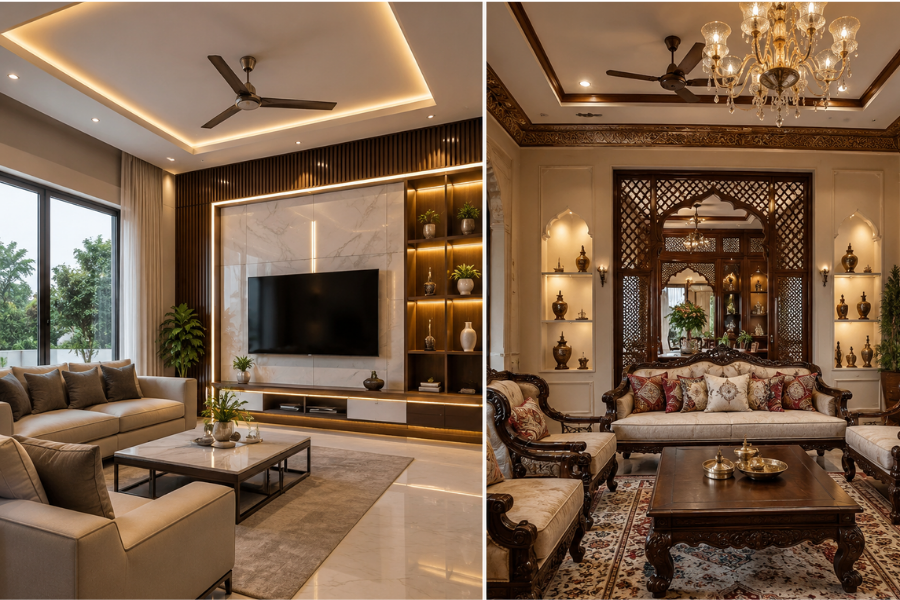
When it comes to modern vs traditional home interiors in Lucknow, this is the same tension that comes up again and again once you start meeting architects or scrolling Pinterest for your new home — should you go modern, or keep things traditional? In Lucknow, this isn’t a small decision. Your interiors need to work with the city’s heat, the joint-family layouts many homes still follow, and a design identity that’s proudly rooted in Nawabi heritage. This guide breaks down both styles honestly, so you can pick what actually fits your home instead of just what looks good online.
What Do “Modern” and “Traditional” Actually Mean in a Lucknow Home?
Modern interiors in Lucknow usually mean clean lines, neutral colour palettes, minimal ornamentation, and open floor plans. Think exposed concrete accents, matte finishes, hidden storage, and furniture that’s more about function than flourish.
Traditional interiors, on the other hand, lean into Lucknow’s own design language — carved wooden furniture, jaali (lattice) work, warm earthy tones, brass fixtures, and layouts built around a central courtyard or a large shared living space where the whole family gathers.
Neither is “better.” They solve different problems. Modern design solves for space efficiency and easy maintenance. Traditional design solves for family living patterns and cultural continuity. Most homeowners we build for end up somewhere in between — and that’s fine.
Modern Home Interiors: What’s Actually Trending Right Now
Minimalist, Multi-Functional Spaces
Plot sizes in newer Lucknow developments — Sushant Golf City, Shaheed Path, Ayodhya Road — are smaller than what previous generations built on. Modern interiors respond to this with furniture that folds, extends, or hides. A dining table that seats four daily and eight on festivals. A study nook built into a wall unit instead of a separate room.
When planning a new home, these space requirements should ideally be considered during the architectural design and BIM planning stage rather than after construction begins.
Neutral Palettes with One Bold Accent Wall
Full-white or full-grey homes have started to feel cold to a lot of our clients. What’s trending instead is a neutral base — whites, greiges, warm off-whites — paired with a single striking accent wall in a bedroom or living room, often in deep green, rust, or navy.
Smart Home Integration
This is the biggest shift we’ve seen in the last two years. Homeowners are asking us to pre-wire for smart lighting, video doorbells, and app-controlled climate control during construction itself, not after moving in. Retrofitting these later means breaking walls and redoing wiring — planning for it early saves both money and mess.
False Ceilings with Cove Lighting
Instead of ornate ceiling work, modern Lucknow homes are going for simple false ceilings with recessed cove lighting — it makes rooms feel taller and adds ambient light without a single chandelier in sight.
Matte and Textured Finishes
Glossy laminates are losing ground to matte finishes — on kitchen cabinets, wardrobes, and even wall paint. Textured wall finishes (limewash, microcement) are also gaining traction among clients who want something that photographs well but doesn’t look like every other new-build apartment.
Traditional Home Interiors: Why They’re Making a Comeback
Carved Wood and Handcrafted Furniture
Solid sheesham and teak furniture with hand-carved detailing — the kind found in Lucknow’s older havelis — is seeing renewed interest, especially from clients building homes for joint families who want something that feels permanent, not disposable.
Jaali Work and Lattice Screens
Jaali partitions are functional as well as beautiful. They let light and air through while creating visual separation between spaces — ideal for open-plan homes that still want a sense of privacy for a puja room or a reading corner.
Rich, Warm Colour Schemes
Deep maroons, mustards, forest greens, and terracotta are showing up again in living rooms and dining areas, often paired with brass or copper accents. It’s a deliberate move away from the all-neutral modern look.
Courtyard-Inspired Layouts
Not everyone can build a full traditional courtyard on today’s plot sizes, but architects are adapting the idea — a central skylight, an open-to-sky utility area, or a covered veranda that mimics the airflow and gathering-space feel of older Lucknow homes.
A Dedicated Puja Room or Corner
This one never really went out of style, but the design of it has evolved. Traditional wood-and-marble puja rooms with intricate detailing remain a non-negotiable for many families, even in otherwise fully modern homes.
Modern vs Traditional Home Interiors in Lucknow: Side-by-Side Comparison
| Factor | Modern Interiors | Traditional Interiors |
| Best for | Nuclear families, smaller plots | Joint families, larger plots |
| Maintenance | Low — easy to clean, fewer intricate surfaces | Higher — carved wood and detailing need upkeep |
| Upfront cost | Moderate, depends on smart tech add-ons | Often higher due to skilled craftsmanship |
| Resale appeal | Broad, especially with younger buyers | Strong with buyers who value heritage and space |
| Climate handling | Relies on AC/ventilation systems | Naturally cooler with courtyards, jaali, thick walls |
| Longevity of style | Trends can feel dated in 8-10 years | Timeless, rarely goes out of fashion |
Can You Mix Both? Yes — And Most Lucknow Homes Already Do
When people ask us about modern vs traditional home interiors in Lucknow, the answer is almost never “fully modern” or “fully traditional” — it’s a blend. A living room with clean modern furniture but a traditional jaali partition behind the sofa. A kitchen with matte modular cabinets but a warm, traditional colour palette. A puja room done in classic style inside an otherwise contemporary layout.
This hybrid approach, sometimes called “modern Indian” or “contemporary heritage,” works particularly well in Lucknow because it respects the city’s design DNA without forcing your home to look like either a Gurgaon apartment or a century-old haveli. If you’re unsure where to start, pick one traditional element you genuinely love — a jaali screen, a wood ceiling detail, a colour scheme — and build the rest of the interior around supporting it, rather than trying to balance dozens of small decisions independently.
Practical Tips Before You Decide
Think about who lives in the house, not just who’s building it. A modern minimalist layout might look stunning, but if your parents are moving in with you, a traditional shared living space might serve the family better day to day.
Factor in Lucknow’s climate from day one. Summers here are intense. Traditional design elements like jaali work, thick walls, and courtyard ventilation genuinely reduce your dependence on air conditioning — worth considering even in an otherwise modern home.
Don’t decide interiors after construction is done. Whether you’re going modern (smart wiring, false ceiling points) or traditional (structural support for heavier carved furniture, jaali wall openings), these decisions need to be part of your construction plan, not an afterthought.
Budget for maintenance, not just installation. Traditional wood furniture and detailing need periodic polishing and pest treatment. Modern matte finishes and laminates are lower-maintenance but can show wear differently over time.
How Wilman Infra Projects Approaches This
At Wilman Infra Projects, we don’t push clients toward one style. During the design phase, we walk through how your family actually uses space — who’s home during the day, whether you entertain often, whether a joint family setup is part of your plan — before recommending a direction. Because interiors are planned alongside the civil and structural work, not bolted on afterward, we can build in the wiring, wall openings, or structural support either style needs from the start, whether that’s smart home pre-wiring or a jaali partition wall.
Frequently Asked Questions
Q1: Is modern or traditional interior design more expensive in Lucknow?
It depends on the specifics. Traditional interiors often cost more upfront due to skilled carpentry and handcrafted detailing, while modern interiors can add cost through smart home technology and imported finishes. A hybrid approach usually gives the most control over budget.
Q2: Can I combine modern and traditional styles in the same home?
Yes, and it’s actually the most common choice among Lucknow homeowners. A typical approach keeps the overall layout and furniture modern while adding traditional accents like jaali screens, a classic puja room, or a warm colour palette in key spaces.
Q3: Which style is better suited to Lucknow’s summer heat?
Traditional design elements — thick walls, courtyards, jaali ventilation — naturally handle heat better and reduce reliance on air conditioning. Modern homes can achieve similar comfort with proper insulation and climate control systems, but that adds to running costs.
Q4: Should I plan my interior style before or during construction?
Before, ideally, or very early in construction. Structural decisions like wall openings for jaali work, ceiling height for false ceilings, or electrical points for smart home devices are far cheaper to plan upfront than to retrofit later.
Q5: Do traditional interiors need more maintenance than modern ones?
Generally yes. Carved wood furniture and detailed finishes need periodic polishing and protection from termites, while modern matte and laminate finishes are comparatively low-maintenance.
Q6: What interior style adds better resale value to a home in Lucknow?
Both can add value depending on the buyer. Modern interiors tend to attract younger nuclear-family buyers, while well-maintained traditional interiors appeal to buyers looking for larger, heritage-style homes. A balanced hybrid design tends to appeal to the widest range of buyers.
Ready to Plan Your Interiors the Right Way?
Whatever you decide about modern vs traditional home interiors in Lucknow, the best results come from planning interiors alongside your construction — not after. Talk to Wilman Infra Projects about building a home in Lucknow that reflects how your family actually lives.